

SEO vs GEO: Why Ranking #1 on Google Still Leaves You Invisible to AI
Ranking high on Google does not guarantee visibility inside AI-generated answers. SGE is changing the game. Learn why SEO alone is no longer enough.
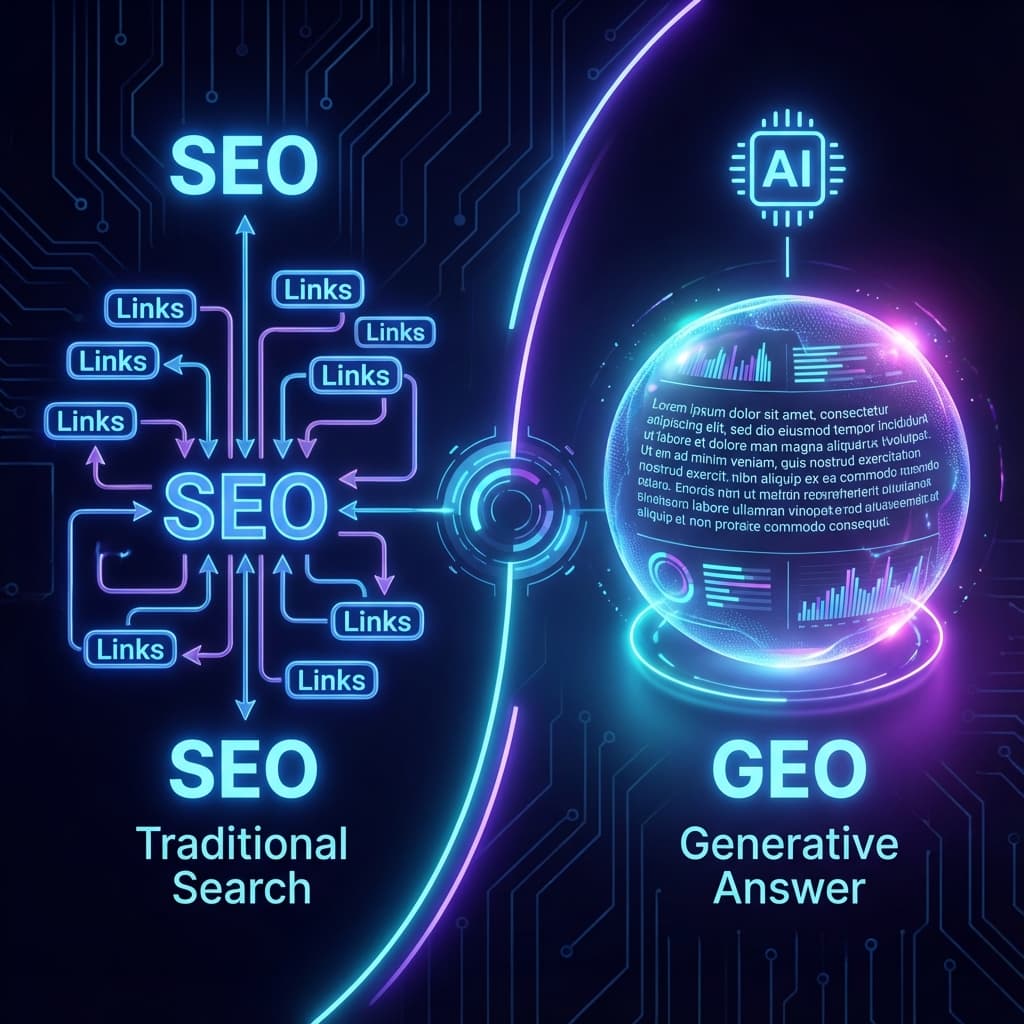
The Shift That Broke the Old Playbook
For over a decade, growth followed a familiar path: Search → Click → Website → Decision
That path is quietly disappearing.
Today, users increasingly skip search results altogether and ask AI assistants direct questions:
- "Which tool should I use?"
- "What's the best option for my use case?"
- "How does this product compare to alternatives?"
Instead of ten links, they get one synthesized answer. And that answer decides which brands exist and which don't.
Direct Comparison: SEO vs GEO
| Dimension | SEO (Search Engine Optimization) | GEO (Generative Engine Optimization) |
|---|---|---|
| Primary goal | Rank higher in search results | Appear in AI-generated answers |
| Discovery interface | Search engines | AI assistants & copilots |
| Output | Clickable links | Summaries, citations, recommendations |
| Optimization target | Crawlers, keywords, backlinks | LLM retrieval, trust, consistency |
| Content style | Keyword & topic coverage | Answer-first, structured, factual |
| Brand control | High (on your site) | Indirect but influenceable |
| Failure mode | Lower traffic | Total invisibility |
| Success signal | Rankings & CTR | Mentions, accuracy, citations |
Why SEO Content Quietly Fails Inside AI Systems
Most SEO content is written to attract clicks. AI content needs to reduce uncertainty. That's the tension.
AI assistants are extremely conservative. They avoid:
- Vague positioning
- Over-marketing language
- Conflicting descriptions
- Unclear category definitions
If your content forces AI to "guess," it won't guess in your favor. It will either:
- Choose a competitor
- Generalize your category
- Or exclude you entirely
This is why strong SEO brands still disappear from AI answers.
What GEO Actually Optimizes (That SEO Never Did)
GEO focuses on things SEO historically ignored. Not more content — better-structured meaning.
It asks:
- Can your product be explained in one clean paragraph?
- Is that explanation consistent everywhere?
- Would an AI feel safe repeating it?
- Does your content answer real questions, not just target keywords?
If the answer is no, AI fills the gaps itself. That's where hallucinations come from.
Where SEO Still Matters — and Where It Stops
SEO is not dead. It still drives:
- Traffic
- Long-form discovery
- Category research
- Content depth
But SEO stops at attention. GEO starts at trust.
Think of it this way: SEO helps users find you. GEO helps AI choose you.
You need both — but they are no longer interchangeable.
What Smart Teams Are Doing Instead
Forward-looking teams aren't abandoning SEO. They're layering GEO on top of it.
They're:
- Auditing how AI currently describes them
- Fixing inconsistencies that cause hallucinations
- Rewriting content to sound like answers, not ads
- Creating canonical explanations AI can reuse safely
They treat AI visibility as a distribution channel, not a side effect.
Share this article